

To Make a Child Think: The Art of Unsettling Minds and Igniting Intellects
Moving Beyond Memory-Based Knowledge to Build True Analytical Intelligence for Life & Competitive Exams
"My idea of education is to unsettle the minds of the young and inflame their intellects." — Robert Maynard Hutchins
I had often wondered why some of my colleagues who were toppers in school or college really never became successful professionals. While they were academically excellent, what was it that they lacked?
Perhaps they pursued knowledge too much. Somewhere they (and our education system made them) believe that if they are full of knowledge, they will be valued.
Years later when I started recruiting people for my own organization, I realized I was not looking for people who can pour out volumes of knowledge – but perhaps I was looking for people who could create, take decisions, solve problems, analyze and then hypothesize, predict and estimate et al. I was looking for people who could THINK!
Factual Questions vs. Thinking Questions
Consider these two questions:
Question 1: "Which gas is filled in gas balloons?"
Question 2: "Which properties of Helium make it ideal for gas balloons?"
The trouble with the former Factual question is that it has one right answer which I have to supply from my memory. The advantage of the latter Thinking question is that I can DEDUCE the answer from my UNDERSTANDING. Also I can come up with more than one answer. It’s quite obvious what kinds of questions will induce, expand and develop thinking.
Here are 5 Guidelines to Develop More Thinking Minds:
Whether you are a parent raising a curious child or an educator guiding candidates preparing for competitive exams like CAT, SSC CGL Tier 1 & Tier 2, SBI PO / IBPS Bank exams, or Telangana (TSLPRB) & Andhra Pradesh (APSLPRB) Police SI and Constable recruitment tests, use these guidelines to build analytical intelligence:
- Do not answer their questions – let them think, research, hypothesize about the possible answers. Avoid looking for immediate answers - Give them time.
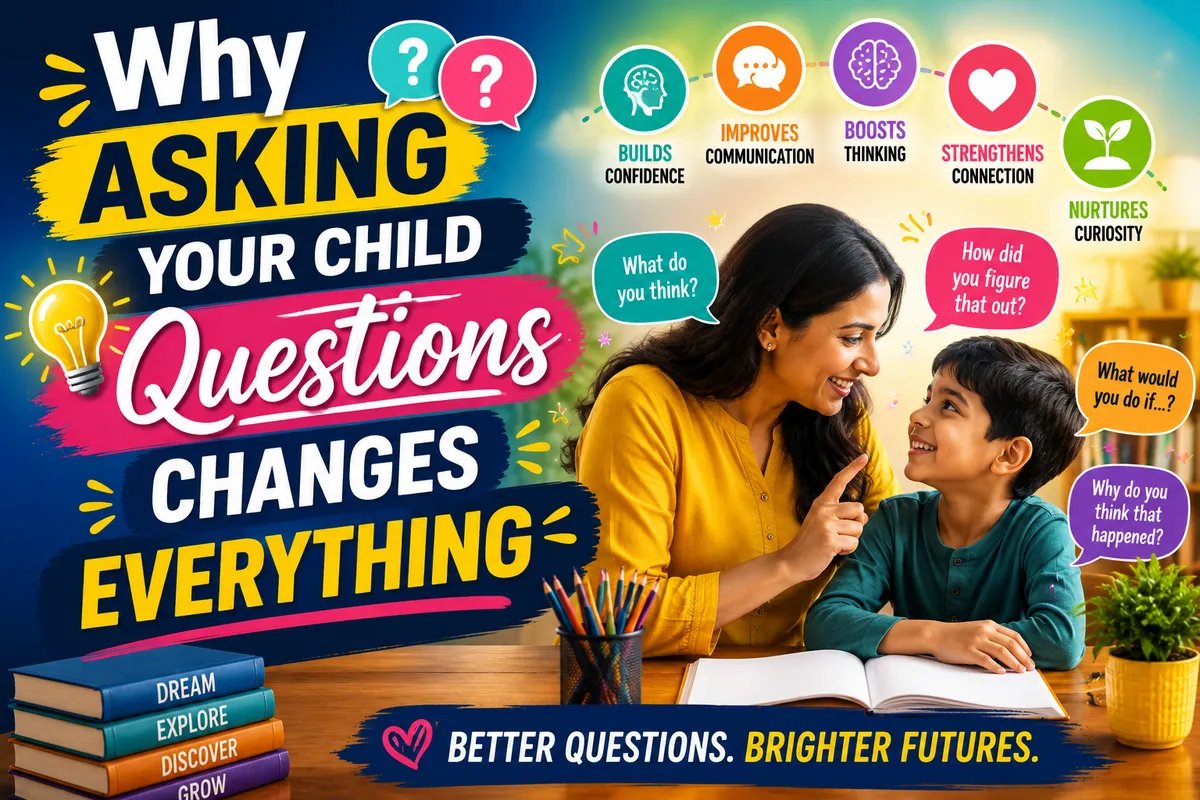
- Ask them open, thinking questions. Remember an answer in a ‘yes’ or ‘no’ or a single word indicates a factual question.
- A good thinking question focuses not on the right answers, but many answers. For e.g.: “Why did Lakshman go with Ram to the forest?” indicates that there is possibly one right answer. However, "what could be the reasons that Lakshman chose to go with Ram" indicates that there are many answers. As a tip - initiate your question with "What" or "How".
- Even if the answers do not tally with your answers – resist the temptation to correct the child. Instead ask more follow-up questions: “How can you support your answer?” or “How can we find out more about this?” etc.
- Even if the child does not reply, remember you have planted a thought seed. Often leaving the children to “keep thinking” about it – without the child replying – is the best strategy. This way they do not have to worry about their communicative ability (language), nor let apprehensions like “what will you think about my answer” come in the way. Remember our task is not to get them to answer our questions, but to make them think.
Freedom to Think: Teaching vs. Exploratory Learning
What is the difference between teaching and learning? To us, learning signifies freedom, responsibility, and ownership.
Scenario 1: Testing Knowledge vs. Exploratory Mind-Work
What are the differences between the following two questions?
- Q1: What is the capital of Arunachal Pradesh?
- Q2: Given a Globe, find out in which state-capital of India will the sun rise first?
While the answer to both questions is the same (Itanagar) - each leads to a completely different type of mind-work. The first question leads to children who - "know". The second question leads to "thinkers".
After the child knows the answer to the first question - the job is over. The second question, however, leads to many questions in itself, and the child may explore:
- The concept of day and night
- Directions - East, West, South, North
- Sun, moon and earth dynamics
- Speed of movement of earth, moon and concept of month/year
- Map of India with states of eastern India
The possibility is unlimited. The first question stops at knowledge (testing) while the second question leads to exploratory learning.
Scenario 2: Excuses vs. Ownership
Now consider these questions:
- Q1: Why are you late?
- Q2: How can you come on time?
The first one brings in a lot of excuses - traffic jam, slept late last night, driver did not turn up, etc. In itself the question achieves - nothing. At best one can threaten, "next time you are late you will be marked absent." But will that motivate the child to take responsibility for coming late?
Now consider the next question - this opens up possibilities; the child gets into thinking - HOW? Maybe set an alarm, travel with another child if the driver is late, and so on. And every time the child is late - he needs to THINK how he can be on time. This may be a longer process (longer than a threat) but it is LONG LASTING. The first leads to defensive children while the second leads to responsible children.
In one of our workshops, parents said: "The first question is negative while the second is positive," and at the same time they said: "We don't always have time to ask the second question." Our response: Time is just an excuse. When we are aware of what works better and what is empowering, we automatically change our approach.
Why Thinking Minds Win in Life & Competitive Exams
At Anil Nair Classes (ANC), we apply these exact principles of exploratory thinking and concept-based learning to prepare students for India's toughest competitive entrance examinations:
- CAT & MBA Entrances: Master Quantitative Aptitude (QA), LRDI Puzzles, Data Interpretation, Arithmetic, and Higher Maths through deep logical questioning rather than formulaic memorization.
- SSC CGL & Central Govt Exams: Conquer Advanced Mathematics (Trigonometry, Geometry, Mensuration, Algebra) and General Intelligence by understanding why a concept works.
- Bank PO & Clerk Exams (SBI/IBPS/RRB): Build speed-math accuracy, master complex Seating Arrangements, Syllogisms, and DI Caselets by training the brain to evaluate option elimination techniques independently.
- Telangana (TSLPRB) & Andhra Pradesh (APSLPRB) SI & Constable Exams: Develop absolute clarity in Arithmetic, Reasoning, Mental Ability, and General Studies in both English and Telugu mediums.
So, do we want questions to teach or do we want questions to learn? Questions that glorify "knowing" or questions that make the child think, explore, and learn?
Transform Your Learning Journey with Anil Nair Classes
Disciplining your child or preparing a student for life's biggest competitive exams doesn't require louder commands or passive lecturing; it requires better questions, concept-based mastery, and proven methodologies.
📱 Download the Official ANC App:
Access bilingual online courses, digital class notes, speed math shortcut modules, chapter-wise practice tests, mock test series, and video lectures directly on your device.
Get the ANC App on Google Play▶️ Subscribe to Our Official YouTube Channel:
Watch free quantitative aptitude masterclasses, marathon revision sessions, PYQ solutions, and shortcut tricks by Anil Nair Sir (22+ Years Teaching Experience).
Subscribe & Watch on YouTube


Leave a Comment
Share your thoughts, doubts, or preparation strategy for this guide.