
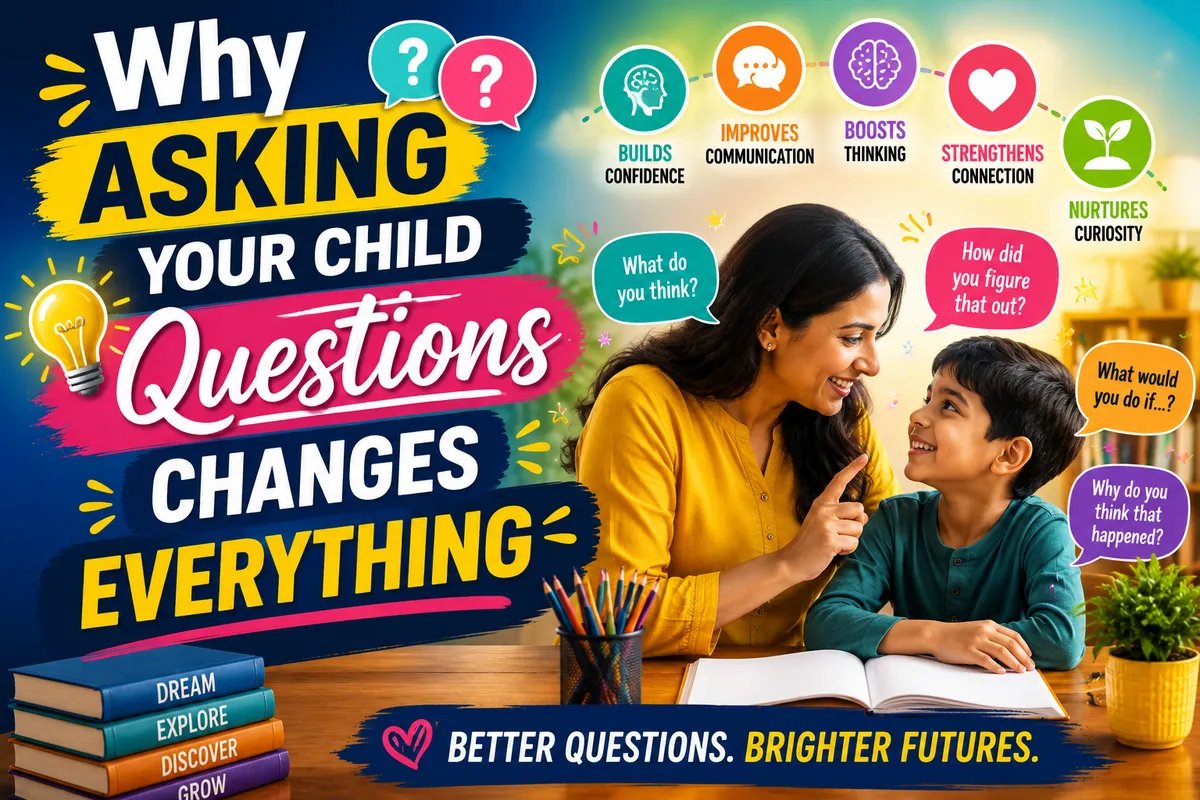
The "Q" Language: Why Asking Your Child Questions Changes Everything
Unlocking Higher Intelligence, Self-Exploration, and Critical Thinking for Life & Competitive Exams
Whenever you stop to think, do you think in terms of passive statements or active questions?
Have you ever asked a question without first processing possible answers in your mind?
When somebody tells you something, it’s easy to tune them out. But when somebody asks you a direct question, can your mind ignore thinking about it? Why is this so? Because questions force engagement. They demand cognitive participation.
Mothers, fathers, educators, and mentors—welcome to a fundamental shift in child psychology, character development, and academic discipline: The "Q" Language. It is a transformative tool for learning, problem-solving, and mind-building that nurtures higher cognitive intelligence—the exact language common to all great thinkers and leaders, from Socrates to Einstein.
Ditch the "T" Language, Embrace the "Q" Language
For generations, traditional parenting and passive classroom teaching have relied heavily on the unproductive "T" Language—Tell them, Tell them, Tell them—and then we wonder why children don't listen or struggle with independent thinking!
It's time to tune into the "Q" Language—Ask them, let them ponder, decide, and answer. Whether you are raising a young child to be an independent thinker or guiding a student preparing for competitive exams like CAT, SSC CGL Tier 1 & Tier 2, SBI PO / IBPS Bank exams, or Telangana (TSLPRB) & Andhra Pradesh (APSLPRB) Police SI and Constable recruitment tests, shifting from commanding to questioning unlocks true cognitive potential.
Practical Examples of the "Q" Language in Action:
1. When Your Child Doesn’t Want to Sleep
Try asking:
- "Why do you think it’s important to take a nap?"
- "How will your body and mind benefit from a good night’s sleep?"
- "What can you and I do together so that you can fall asleep easily?"
2. When Your Child Forgets to Wash Their Hands
Try asking:
- "Why do you think we wash our hands before eating?"
- "How does washing hands help keep us healthy?"
- "Is this something we need to do every day? Why?"
3. When Your Child Demands Too Much Screen Time
Try asking:
- "What do you want to become when you grow up?"
- "What steps will help you achieve that career dream?"
- "How much does watching TV help you reach that target?"
- "What else could we do today that gets you closer to what you want to achieve?"
4. When Your Student or Child Gets Low Marks in Math or Aptitude Tests
Instead of scolding over scores in Quantitative Aptitude or Reasoning, try asking:
- "Which parts of your performance or mock test analysis are you most pleased with?"
- "In what ways are you looking forward to improving your speed and accuracy during the next exam?"
- "What kind of help, concepts, or short tricks do you need from me or your mentor?"
5. When Your Child Plays with Dangerous Objects (Plugs, Knives, Glass)
Try asking:
- "Why do you think we ask you not to play with knives or outlet plugs?"
- "In what ways could these objects hurt someone?"
- "At what age do you think you’ll be ready to use these safely?"
6. When Your Child Delays Homework or Study Hours
Try asking:
- "How can we make solving practice questions and mock tests more interesting today?"
- "What fun things can we do once study hours are finished?"
- "How does mastering Arithmetic, English, and Reasoning concepts help your mind grow?"
7. When Your Child Struggles to Understand a Complex Concept
Whether basic school arithmetic or advanced topics like Algebra, Geometry, Data Interpretation (DI), or Puzzles, try asking:
- "What part of this problem have you already understood?"
- "What does this concept look similar to, or different from?"
- "Which step was easy for you? Would you like to try solving the next step yourself first?"
The Golden Rule: Avoid Rhetorical Traps
Questions like "Who did this?", "Why can't you ever listen?", or "How could you get low marks like this?" are not real questions. They are masked judgments designed to induce guilt, yielding no positive learning outcomes.
To make the "Q" Language work:
- Remove Judgment: Keep questions non-threatening and forward-looking.
- Focus on Growth: The objective isn't to test your child’s current knowledge; it is to expand their intelligence through self-exploration and analytical thinking.
- Refrain from Immediate Correction: Let children own their discoveries—even if their initial answers aren't perfect. The most powerful learning happens when a child realizes the truth on their own and says, "You know, Mum/Dad, I realized why that happened."
Why Questions Are Magical in Learning and Competitive Prep
Building strong analytical thinking through questioning is the exact secret weapon needed for cracking high-stakes competitive entrance exams coached at Anil Nair Classes (ANC):
- CAT & MBA Entrances: Master Quantitative Aptitude (QA), LRDI Puzzles, Data Interpretation, Arithmetic, and Higher Maths through deep logical questioning rather than formulaic memorization.
- SSC CGL & Central Govt Exams: Conquer Advanced Mathematics (Trigonometry, Geometry, Mensuration, Algebra) and General Intelligence by understanding why a concept works.
- Bank PO & Clerk Exams (SBI/IBPS/RRB): Build speed-math accuracy, master complex Seating Arrangements, Syllogisms, and DI Caselets by training the brain to evaluate option elimination techniques independently.
- Telangana (TSLPRB) & Andhra Pradesh (APSLPRB) SI & Constable Exams: Develop absolute clarity in Arithmetic, Reasoning, Mental Ability, and General Studies in both English and Telugu mediums.
Core Benefits of the "Q" Language:
- They Stimulate Critical Thinking: Questions activate the brain, encouraging active problem-solving rather than passive compliance.
- Children Own the Solutions: When children articulate the answer, they own the choice—and by extension, they own the consequence.
- They Eliminate Power Struggles: Questions give children a voice. Being heard reduces conflicts and makes cooperation natural.
- They Shift Focus Forward: Instead of dwelling on past mistakes, effective questions look toward future possibilities.
- They Flip the Dynamic: Asking turns your child or student into the speaker and you into the listener, fostering trust, confidence, and emotional maturity.
What to Do When They Say "I Don't Know"
When a child or student eventually responds with "I don't know," it isn't a failure—it's an invitation. They have opened a mental window for you to guide them.
When this happens, keep your response short, clear, and simple. Avoid turning it back into a long lecture. Plant the thought gently and let it settle.
"A good question is never answered. It is not a bolt to be tightened into place, but a seed to be planted and to bear more seeds toward the hope of greening the landscape of mind."
— John Ciardi
Transform Your Learning Journey with Anil Nair Classes
Disciplining your child or preparing a student for life's biggest competitive exams doesn't require louder commands or passive lecturing; it requires better questions, concept-based mastery, and proven methodologies.
📱 Download the Official ANC App:
Access bilingual online courses, digital class notes, speed math shortcut modules, chapter-wise practice tests, mock test series, and video lectures directly on your device.
Get the ANC App on Google Play▶️ Subscribe to Our Official YouTube Channel:
Watch free quantitative aptitude masterclasses, marathon revision sessions, PYQ solutions, and shortcut tricks by Anil Nair Sir (22+ Years Teaching Experience).
Subscribe & Watch on YouTube




Leave a Comment
Share your thoughts, doubts, or preparation strategy for this guide.